
Can Somatic Tools Really Help Your Anxiety? How to Integrate Movement with Holistic Psychiatry

Have you ever been sitting in a high-stakes meeting, or maybe just trying to get a toddler to eat their peas, when suddenly your heart starts racing like you’ve just sprinted a 5K? Your palms get clammy, your chest feels tight, and even though you know you’re safe, your body is screaming that there’s a literal bear in the room.
Welcome to another edition of "Body Notes." I’m Antoinette, and if we haven’t met yet, I wear two very cool hats: I’m a Student Dance Movement Therapist and a Holistic Psychiatric Nurse Practitioner (PMHNP). In my world, we don’t just talk about what’s happening in your head; we talk about what’s happening in your bones, your breath, and your muscles.
One of the most common questions I get from my clients here in Maryland is: "Antoinette, I’m taking my meds, and they help, but I still feel... jumpy. Can movement actually do anything for my anxiety?"
The short answer? Yes. The long answer involves a beautiful dance between your nervous system, your medication, and the way you move through the world. Let’s dive into why somatic tools are the missing piece of the puzzle in holistic psychiatry.
Anxiety Isn't Just "In Your Head"
We’ve been conditioned to think of anxiety as a collection of "worried thoughts." We think if we can just "logic" our way out of it or "think positive," the anxiety will vanish. But if you’ve ever had a panic attack, you know that logic goes out the window when your body takes over.
Anxiety is a physiological event. It’s your sympathetic nervous system, your "fight or flight" response, getting stuck in the "on" position. When this happens, your body stores that energy. Even if the stressful event is over (the meeting ended, the kid finally ate the peas), that humming vibration of "danger" can stay trapped in your shoulders, your gut, and your jaw.
As a holistic psych NP, I look at the whole picture. Medication can be an incredible tool to lower the "volume" of that noise, making it easier to function. But somatic tools? They help you actually "clear the tab" that your nervous system has kept open.
What Are Somatic Tools, Anyway?
"Somatic" just means "of the body." Somatic tools are simple techniques that use physical movement, breath, or touch to communicate directly with your nervous system.
Think of it this way: Your brain and your body are in a constant text thread. Usually, we try to send texts from the Brain to the Body ("Hey, calm down!"). Somatic work sends texts from the Body to the Brain ("Hey, we are moving rhythmically and breathing deeply, so we must be safe").
Here are a few ways we integrate this into affirming psychiatric care:
1. Grounding (The "I Am Here" Reset)
When anxiety hits, we often "check out" or feel floaty. Grounding pulls you back into the present.
The Somatic Twist: Instead of just naming things you see, try feeling the weight of your feet on the floor. Push your heels down. Feel the resistance of the earth. This sends a signal of stability to your brain.
2. Rhythmic Movement
As a dance movement therapist, this is my favorite. Have you ever noticed how babies stop crying when they are rocked? Our nervous systems crave rhythm.
Try this: If you’re feeling a spike of anxiety, try a gentle side-to-side sway. Or, if you’re alone, put on a song with a steady beat and just tap your toes or march in place. This helps "complete" the stress response energy that’s looking for a way out.
3. The "Vagus Nerve" Sigh
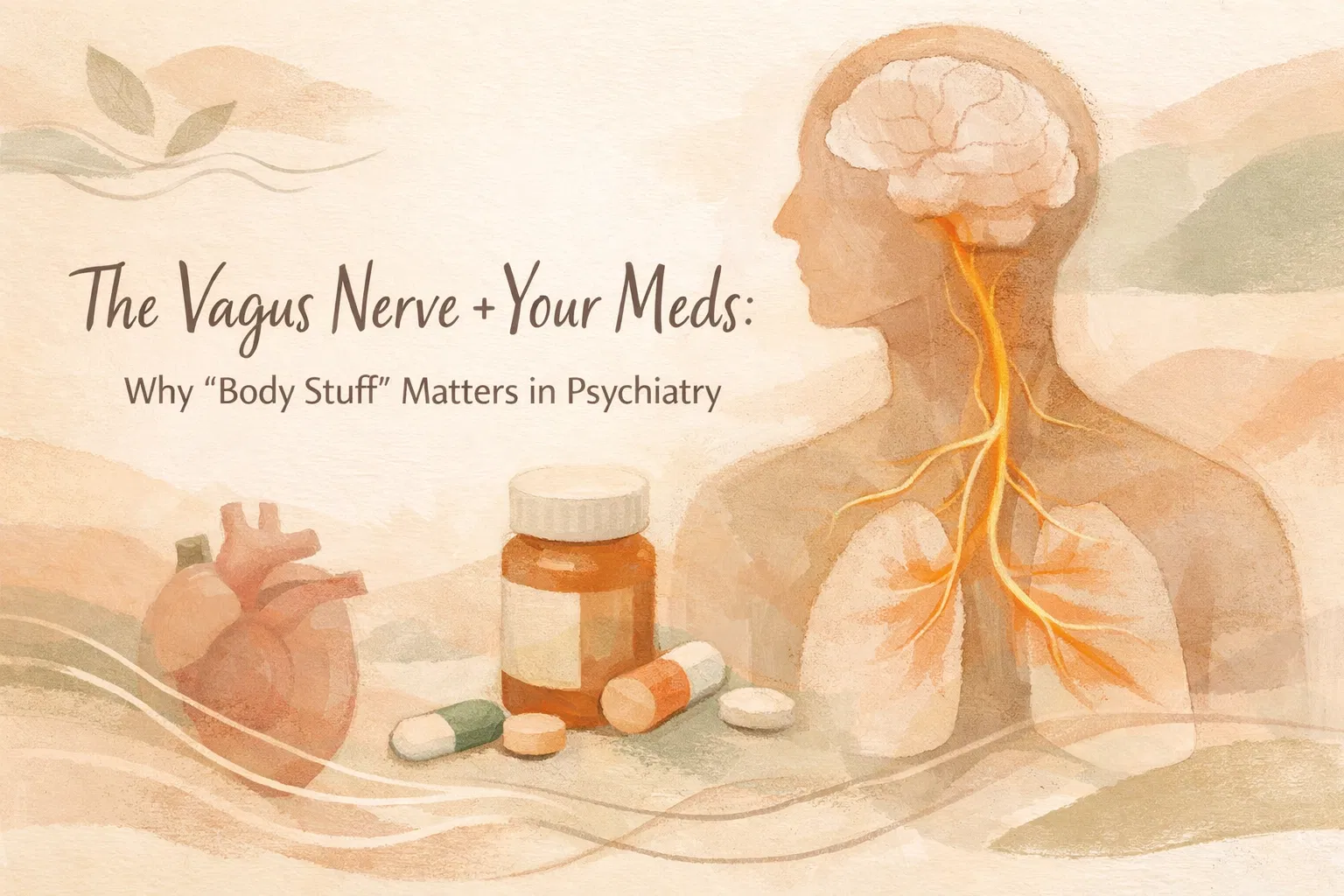
We’ve talked about the vagus nerve and your meds before, but it bears repeating.
Try this: Inhale deeply, and as you exhale, make a low "vooooo" or "hummm" sound. The vibration in your chest stimulates the vagus nerve, which tells your parasympathetic nervous system (the "rest and digest" crew) to take the wheel.
Why Integration is the "Secret Sauce"
In traditional psychiatry, you might get a prescription and a "see you in a month." In holistic psychiatry, we realize that medication works better when your body is a receptive environment.
Think of medication like a life jacket. It keeps your head above water so you don’t drown in the waves of anxiety. But somatic tools? They teach you how to swim. When we combine the two, you aren’t just surviving the storm; you’re learning how to navigate the water.
This is especially important for my fellow Marylanders, the career starters in Baltimore, the busy parents in the suburbs, and the college students across the state. You’re under a lot of pressure. If we only treat your symptoms with a pill but don't give you the tools to regulate your body during a 10:00 AM presentation, we’re only doing half the job.
Culturally Responsive & Affirming Care
I also want to acknowledge that for many of us, especially in BIPOC and LGBTQ+ communities, the body hasn't always felt like a safe place. Systemic stress, microaggressions, and community trauma can make "being in your body" feel scary or even revolutionary.
Part of what culturally responsive care actually looks like is recognizing that your body’s anxiety might be a very logical response to the world around you. We don't pathologize that. Instead, we use somatic tools to reclaim your body as your own home. You are allowed to take up space. You are allowed to move in ways that feel good to you.
Is This Right For You?
If you’ve been struggling with anxiety and you feel like you’ve reached a plateau with "just talking" or "just meds," it might be time to bring your body into the conversation.
You don’t have to be a dancer. You don’t have to be "good" at movement. Somatic work isn't about how you look; it's about how you feel from the inside out.
At Inside and Out Psychiatry, we specialize in this middle ground. Whether you are navigating eating disorder recovery or just trying to manage the grind of early parenthood without losing your mind, we’re here to help you integrate these tools into your life.
A "Body Note" to Take With You
Next time you feel that familiar prickle of anxiety, I want you to try one tiny thing. Just one.
Notice where the tension is (Jaw? Shoulders? Gut?).
Soften that one spot, just 5%.
Take one breath where the exhale is longer than the inhale.
That’s it. You just did somatic work. You just communicated with your nervous system.
If you’re ready to explore a more inclusive mental health approach in Maryland, I’d love to walk (or dance!) this path with you. We can look at your medication, your lifestyle, and your movement patterns to find a plan that actually feels like you.
Ready to dive deeper? You can learn more about my approach here or book a session to start your own journey toward embodied healing.
Your body is not the enemy. It's just trying to tell you something. Let's learn how to listen together.
Disclaimer: This blog is for educational purposes and does not replace professional medical advice. If you are experiencing a mental health emergency, please call 988 or go to your nearest emergency room. To understand how we protect your data, please see our privacy policy.
Comments